Beyond the $4 List: What Discount Generic Programs Don't Put on the Sign
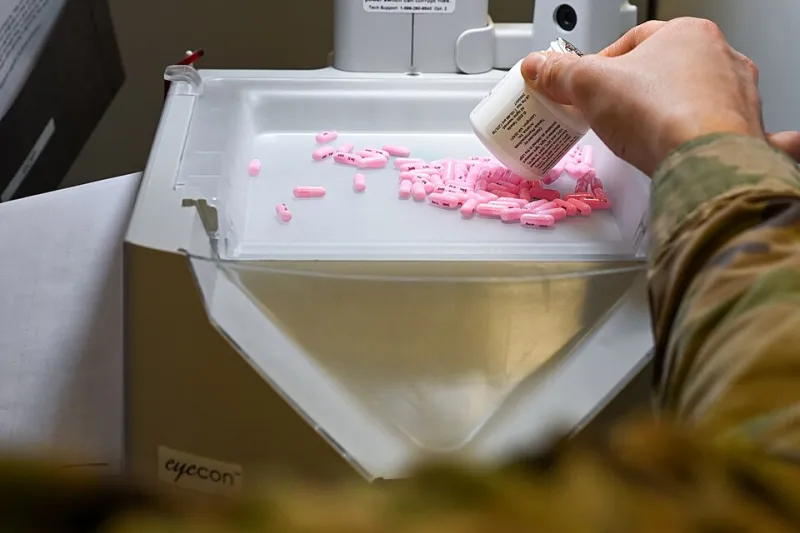
Photo: U.S. Air Force photo by Senior Airman Jessica Sanchez-Chen, Public domain, via Wikimedia Commons
Discount generic programs — most famously the $4 prescription list introduced by Walmart in 2006 and since replicated by Kroger, Publix, Wegmans, and dozens of regional chains — have become a fixture of American pharmacy economics. For consumers without insurance or with high-deductible plans, these lists can mean the difference between filling a prescription and walking away. Yet the advertised price is a starting point, not a guarantee. Understanding how these programs actually function is a matter of both financial literacy and medication safety.
How $4 Generic Lists Actually Work
These programs are cash-price arrangements: the pharmacy offers a curated roster of older, widely manufactured generics at a flat rate, typically $4 for a 30-day supply or $10 for 90 days. The list is possible because many off-patent medications — metformin, lisinopril, atorvastatin, amlodipine — cost pennies per tablet to produce in bulk.
Crucially, the flat price applies only to medications on that specific list, and each retailer's list differs. A drug on Kroger's program may be absent from Walmart's, and vice versa. Prescribers rarely know these lists in detail, so the burden of matching a prescription to a discount program usually falls on the patient.
What the Sign Doesn't Say
Formulation and Dosage Restrictions
Discount pricing often applies only to specific strengths or forms. A 500 mg tablet may be covered while an extended-release version is not. Liquid formulations, orally disintegrating tablets, and combination products frequently fall outside the program entirely — a particular issue for pediatric and geriatric patients who cannot swallow standard tablets.
Quantity Limits
Most programs cap coverage at a standard 30- or 90-day supply. Prescriptions written for larger quantities, or for medications requiring titration with frequent dose changes, may not fit the program's structure.
The Substitution Question
Some programs steer patients toward a therapeutically equivalent but chemically different drug — for instance, offering one ACE inhibitor on the $4 list while a prescribed alternative is not included. While generic substitution within the same molecule is regulated by the FDA and generally appropriate, switching to a different drug in the same class is a clinical decision, not a pricing one. Patients should never accept a class swap without their prescriber's explicit approval.
Excluded Drug Classes
Newer generics, controlled substances, and specialty medications are almost universally excluded. Drugs that have recently come off patent — where only one or two manufacturers hold abbreviated approvals — often remain expensive regardless of the list. The $4 roster favors commodities, and anything requiring an FDA-registered manufacturing niche will not be on it.
Comparing Discount Lists Effectively
A practical comparison takes minutes and can save hundreds of dollars annually:
- Pull the current list from each retailer's website. These lists are updated periodically, and printed copies in stores may be outdated.
- Match exact drug, strength, and quantity. A partial match is not a match.
- Check pharmacy location participation. Not every branch of a chain participates, particularly in certain states.
- Ask the pharmacist to run the cash price before committing. Pharmacists can quote program pricing without filling the prescription.
Savings Cards and the Cash-Pricing Maze
Prescription savings cards from services such as GoodRx, SingleCare, and WellRx negotiate their own discounted rates with pharmacy benefit managers. These cards are free to use and can beat both the $4 lists and insurance copays — particularly for generics not included in any flat-rate program.
However, card prices fluctuate week to week and vary by pharmacy location. A card that offered the best price last month may not this month. There is also a record-keeping consequence: purchases made with a savings card do not count toward insurance deductibles or out-of-pocket maximums, which matters for patients who eventually reach catastrophic coverage thresholds.
When Insurance Wins
The most common consumer error is assuming the discount list is always the cheapest option. Consider three scenarios where it is not:
- Deductible progress. Paying cash bypasses the insurer entirely, meaning the spending does not accumulate toward the deductible. For patients close to meeting theirs, running prescriptions through insurance may be more economical over the plan year.
- Formulary copays below $4. Many insured plans carry $0 to $10 copays for tier-one generics, sometimes with no deductible for preventive medications.
- Manufacturer assistance. Brand-name drugs with copay cards or patient assistance programs can cost less out of pocket than any cash alternative — though these apply only to brand products, never generics.
Patients are legally entitled to ask their pharmacist to compare prices across methods, and many states have transparency rules supporting this request. Pharmacists cannot always volunteer the comparison due to contractual constraints with insurers, but they can respond when asked directly.
A Safety Note on Program Hopping
Price-shopping across pharmacies has one underappreciated risk: fragmentation of the medication record. When a patient fills prescriptions at multiple locations, no single pharmacist sees the complete picture, weakening the last line of defense against dangerous drug interactions. Patients using discount programs across several chains should maintain a current medication list — or consolidate all cash purchases at one pharmacy whenever feasible — and share it at every prescriber visit.
The Bottom Line
Discount generic programs deliver real value for a narrow band of common, older medications, and they remain a legitimate tool for the uninsured and underinsured. But the advertised $4 price is a marketing anchor, not a comprehensive benefit. The safest approach combines three habits: verify the exact drug and strength against the current list, compare the cash price against savings cards and insurance copays before paying, and keep one pharmacy informed of the complete regimen. In pharmaceutical economics, as in clinical medicine, the correct dose of skepticism prevents most adverse events.